

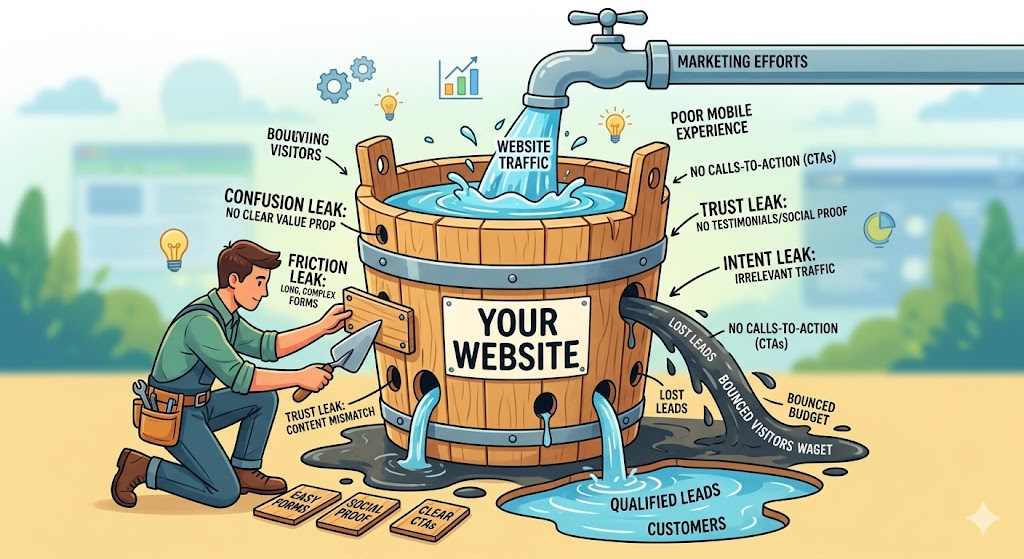

Getting traffic to your website feels like a win. You see the numbers climbing in your analytics and it looks like things are working. But then reality hits. No form submissions. No calls. No actual business.
Traffic without leads is just noise.
If this sounds familiar, the issue is not visibility. It is conversion. Let’s break down why this happens and how you can fix it step by step.
The Real Problem Behind “No Leads”
Most websites focus heavily on SEO and forget what happens after the click. Ranking is only the first part. What happens next determines whether that visitor becomes a customer.
In many cases, your website is doing one of three things wrong:
- Attracting the wrong audience
- Failing to communicate value clearly
- Making it hard for users to take action
Now let’s fix it.
Not all traffic is good traffic.
Step 1: Align Traffic with Intent
If you are ranking for broad or irrelevant keywords, you will attract people who are not ready to buy. For example, someone searching for “what is digital marketing” is not in the same mindset as someone searching for hire a digital marketing agency.
Check your top pages and keywords. Ask yourself a simple question. Are these visitors likely to convert?
If the answer is no, shift your strategy toward high intent keywords. Focus on phrases that show buying or decision intent.
Step 2: Fix Your Messaging Above the Fold
When someone lands on your site, you have a few seconds to make your point clear.
Most websites fail here. They use vague headlines like “We help businesses grow.” That does not mean anything to a new visitor.
Instead, be specific.
Say what you do, who you do it for, and the result they can expect. Make it impossible to misunderstand your offer.
Clarity beats creativity every time.
Step 3: Strengthen Your Call to Action
A lot of websites either hide their call to action or make it weak.
“Learn more” is not a strong CTA.
Tell people exactly what to do next. Use direct language like:
- Get a free quote
- Book a call
- Start your project
Also, make sure your CTA is visible without scrolling. Then repeat it naturally across the page.
Step 4: Improve Page Experience
If your website is slow, cluttered, or hard to navigate, people will leave.
This is not just about design. It is about trust and usability.
Check the basics:
- Page load speed
- Mobile responsiveness
- Clean layout
- Easy navigation
Every extra second of load time reduces your chances of conversion.
Step 5: Add Trust Signals
Visitors do not trust you yet. That is normal.
You need to earn that trust quickly.
Add elements that show credibility:
- Testimonials from real clients
- Case studies with results
- Reviews and ratings
- Logos of past clients or partners
Social proof reduces doubt and makes it easier for people to take action.
Step 6: Simplify Your Conversion Path
If your form has too many fields, people will not fill it.
If your process is confusing, people will drop off.
Make it easy.
Only ask for what you need. Keep forms short. Reduce friction at every step.
If possible, offer multiple ways to convert. Some people prefer forms. Others prefer calls or chat.
Step 7: Track and Optimize Continuously
This is where most people stop too early.
You cannot guess what is working. You need data.
Set up tracking for key actions like form submissions and clicks. Use tools like heatmaps to see how users behave on your pages.
Then test changes.
Try different headlines. Adjust your CTAs. Move elements around. Small changes can lead to big improvements over time.
A Quick Reality Check
You might be thinking your problem is traffic. In many cases, it is not.
If 1,000 people visit your site and none convert, bringing in another 1,000 will not fix the issue.
Conversion comes from alignment. The right message, to the right person, at the right time.
Final Thoughts
Getting traffic is only half the job. Turning that traffic into leads is where real growth happens.
Start with intent. Fix your messaging. Make it easy for users to act. Then keep improving based on data.
If you apply these seven steps properly, you will not just see more leads. You will see better leads.
And that is what actually drives business forward.


